
Why Soil Testing Matters Before Planting: A Farmer’s Guide to Better Yields
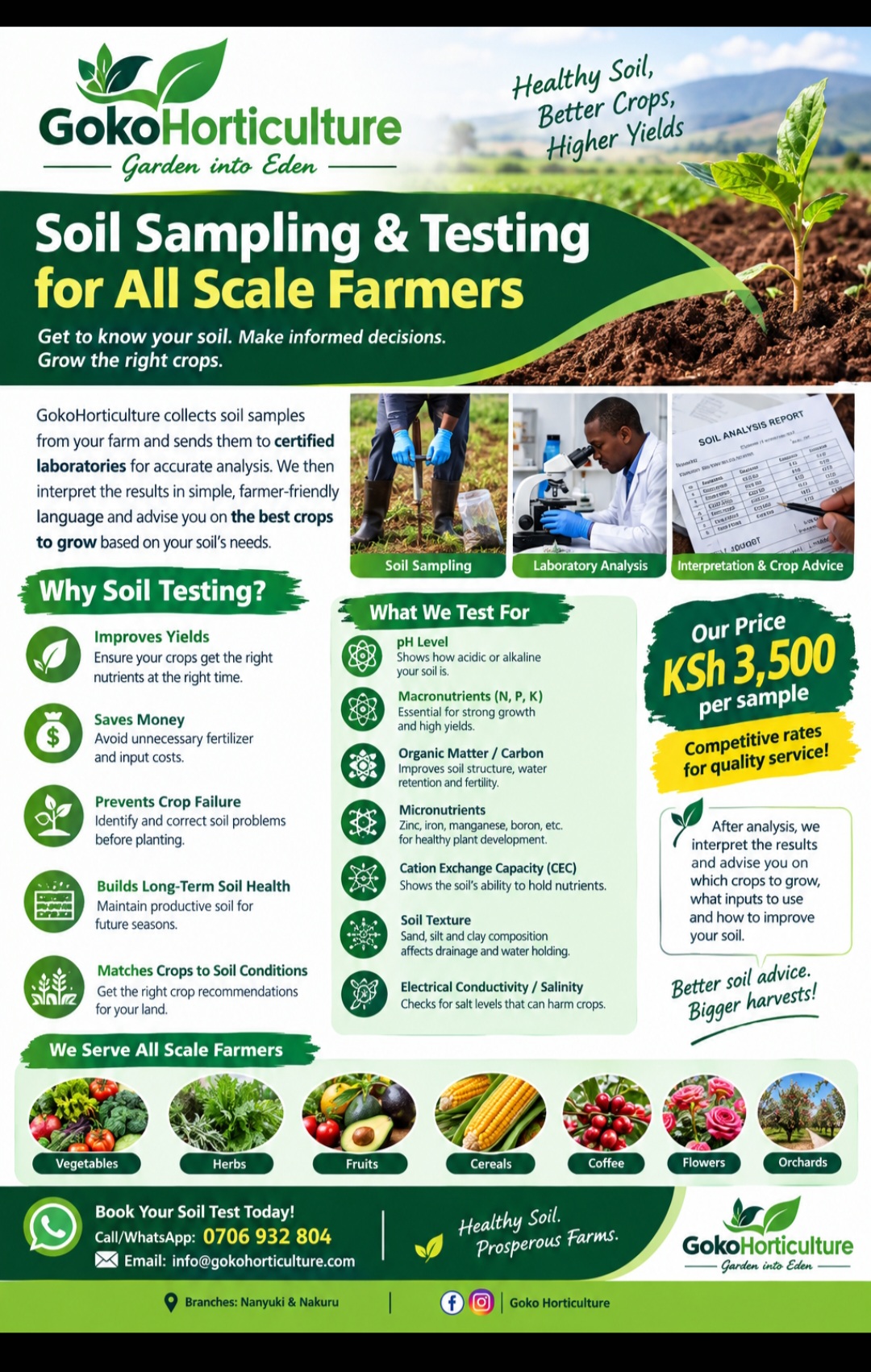
Soil Testing for Farmers: Why It Is the First Step to a Successful Harvest
For many farmers, planting begins with buying seed, preparing the land and applying fertilizer. But there is one important step that is often skipped: soil testing for farmers.
Planting without knowing what is happening beneath the soil can be an expensive gamble. You may apply expensive fertilizer and still get poor yields. Your crops may show nutrient deficiency symptoms even though you have applied enough fertilizer. In some cases, the soil may have the wrong pH, poor drainage, excessive salinity or another problem that prevents crops from using available nutrients.
A simple soil test can help eliminate much of this guesswork.
Whether you are growing vegetables, herbs, cereals, fruits, coffee, potatoes, flowers or establishing an orchard, soil testing provides the foundation for informed farm management. It tells you what your soil has, what it lacks and what needs to be corrected before or during crop production.
Why Soil Testing Matters Before Planting
1. Soil testing reduces guesswork
Every farm is different. Even two fields located next to each other can have different soil properties because of differences in previous cropping, fertilizer application, erosion, manure use, irrigation and drainage.
Using a fertilizer recommendation simply because a neighbouring farmer uses it may therefore produce poor results.
A soil analysis gives you actual information about your field.
Instead of asking, "How much fertilizer should I apply?", you can begin with better questions:
What nutrients are already available?
Which nutrients are deficient?
Is the soil acidic or alkaline?
Does the soil have enough organic matter?
Is salinity a problem?
Can the soil hold and supply nutrients effectively?
Is the soil suitable for the crop I want to grow?
This information allows fertilizer and soil-management decisions to be based on evidence rather than assumptions.
2. It can save money on fertilizer
Fertilizer is one of the major production costs for many farmers. Applying more fertilizer does not necessarily mean producing more.
If your soil already contains adequate phosphorus, for example, adding large quantities of phosphorus fertilizer may provide little economic benefit. Similarly, applying nitrogen without considering the crop's actual requirements and the soil's existing nutrient status can lead to unnecessary expenditure.
A soil test helps you identify where your money is most likely to produce a return.
The goal is not simply to use less fertilizer. The goal is to use the right fertilizer, in the right quantity, at the right time and in the right place.
3. It helps match crops to soil conditions
Different crops have different soil requirements.
Some crops perform best in slightly acidic soils, while others are more sensitive to acidity or salinity. Crops such as blueberries, for example, have particularly specific soil requirements and cannot simply be planted successfully in every field without considering pH, drainage and other factors.
Before establishing a new crop, soil testing can therefore help determine whether the existing soil is suitable or whether rehabilitation will be required.
This is particularly important when establishing high-value crops such as herbs, berries, coffee, avocado, vegetables and fruit orchards.
4. It supports long-term soil health
Good farming is not only about getting a good harvest this season. It is also about maintaining productive soil for future seasons.
Repeated cropping can remove nutrients from the soil. Poor fertilizer management, erosion, excessive cultivation and inadequate organic matter can gradually reduce soil productivity.
Regular soil testing helps farmers monitor these changes and develop a long-term soil fertility management programme.
Key Parameters Tested in Soil Analysis
A professional soil analysis can measure several physical and chemical properties. The exact tests required depend on the crop, location and farming system.
1. Soil pH
Soil pH indicates how acidic or alkaline the soil is.
The pH scale generally runs from 0 to 14, with 7 considered neutral. Most agricultural crops perform well within a moderately acidic to near-neutral range, although the ideal range varies between crops.
Why does pH matter?
Because soil pH influences nutrient availability. A soil can contain nutrients but still make some of them difficult for plants to absorb if the pH is unsuitable.
If soil is excessively acidic, farmers may need to consider amendments such as agricultural lime, depending on the laboratory recommendation.
Important: Do not apply lime simply because a crop is performing poorly. Test the soil first and determine the appropriate amendment rate.
2. Nitrogen (N), Phosphorus (P) and Potassium (K)
These are commonly referred to as the primary macronutrients.
Nitrogen (N)
Nitrogen is strongly associated with vegetative growth, leaf development and overall plant vigour.
A nitrogen deficiency can result in poor growth and pale or yellowing older leaves. However, excessive nitrogen can also create problems, including excessive vegetative growth and potential effects on crop quality.
Phosphorus (P)
Phosphorus plays an important role in root development, energy transfer and reproductive development.
Low phosphorus availability can restrict root growth and crop establishment.
Potassium (K)
Potassium supports several plant processes, including water regulation, enzyme activity and crop quality.
Adequate potassium is particularly important for many fruit and vegetable crops.
A soil test helps establish whether these nutrients are deficient, adequate or excessive and supports more precise fertilizer planning.
3. Organic Matter and Organic Carbon
Organic matter comes from decomposed plant and animal materials in the soil.
It contributes to soil structure, water-holding capacity, nutrient cycling and biological activity.
Soils with low organic matter may have poor structure and reduced ability to retain moisture and nutrients.
Farmers can improve organic matter through appropriate use of well-decomposed manure, compost, crop residues, cover crops and other organic inputs.
However, organic amendments should also be used intelligently. More is not automatically better.
4. Micronutrients
Plants require micronutrients in much smaller quantities than nitrogen, phosphorus and potassium, but they are still essential.
Commonly tested micronutrients include:
Zinc (Zn)
Iron (Fe)
Manganese (Mn)
Boron (B)
Copper (Cu)
Molybdenum (Mo)
A deficiency in a micronutrient can affect plant growth, flowering, fruit development or overall crop performance.
Because deficiency symptoms can resemble diseases, pest damage or other nutrient problems, laboratory analysis can help identify the actual cause before corrective action is taken.
5. Cation Exchange Capacity (CEC)
CEC is a measure of the soil's ability to hold positively charged nutrients, known as cations.
Think of it as part of the soil's nutrient-holding capacity.
Soils with higher CEC generally have greater capacity to retain nutrients such as calcium, magnesium and potassium, while sandy soils often have lower CEC.
CEC can therefore help agronomists understand how a soil is likely to retain and supply nutrients and how fertilizer management should be approached.
6. Soil Texture
Soil texture describes the relative proportions of sand, silt and clay.
A sandy soil generally drains quickly but may have limited water and nutrient-holding capacity.
Clay soils can hold considerable water and nutrients but may drain slowly, become waterlogged or develop compaction problems.
Loam soils, depending on their specific composition and structure, can provide a useful balance of drainage, water retention and nutrient-holding capacity.
Understanding soil texture is especially important when designing irrigation, drainage, fertigation and soil rehabilitation programmes.
7. Electrical Conductivity and Salinity
Electrical conductivity (EC) is commonly used as an indicator of the concentration of soluble salts in soil or irrigation water.
Excessive salinity can make it difficult for plants to absorb water and can reduce crop performance.
This is particularly important in irrigated agriculture and areas where drainage is poor.
If high salinity is detected, management may involve improving drainage, managing irrigation water, reducing salt accumulation and implementing other corrective measures recommended by an agronomist.
How to Interpret Soil Test Results
Receiving a soil laboratory report can initially look complicated. Fortunately, farmers do not need to be soil scientists to understand the most important information.
Start with the crop you intend to grow
There is no single "perfect soil test result" for every crop.
The interpretation should consider:
The crop
Expected yield
Soil type
Climate
Irrigation
Previous crop
Fertilizer and manure history
The laboratory's reference ranges
Therefore, do not look at one number in isolation.
Understand the optimal range
Laboratories normally provide reference or interpretation ranges showing whether a particular parameter is low, adequate or high.
For example, a report might classify potassium as low, medium or high.
A result classified as low indicates that the nutrient may need supplementation. An adequate result suggests that additional application may not be necessary at the same rate. A very high result may indicate that applying more could be wasteful or potentially harmful.
The exact interpretation depends on the crop and laboratory methodology.
Identify deficiencies and possible toxicities
A soil test can highlight nutrient deficiencies, but it can also identify excessive levels.
This distinction is important.
Farmers sometimes assume that if a crop is weak, the solution is simply more fertilizer. But excessive nutrients, unsuitable pH, salinity, poor drainage or other soil problems can also reduce crop performance.
The correct response should therefore address the underlying problem rather than automatically increasing fertilizer rates.
Turn the results into an action plan
The most useful soil test is one that leads to action.
For example, the results may indicate the need for:
Low pH → possible liming, based on the laboratory's recommendation.
Low organic matter → appropriate compost, manure, crop residues or other organic matter strategies.
Low phosphorus → targeted phosphorus fertilization.
Low potassium → potassium-containing fertilizer or another suitable nutrient source.
High salinity → improved drainage and irrigation/salt-management practices.
Poor physical condition → soil-structure and water-management interventions.
The important point is that the soil report should guide the recommendation rather than the other way around.
Soil Testing Is an Investment, Not an Expense
For a smallholder farmer, paying for soil analysis may initially feel like another farm expense.
But compare the cost of a soil test with the cost of applying the wrong fertilizer across several acres.
For commercial farmers, the potential savings can be even greater.
Suppose a farmer spends hundreds of thousands of shillings preparing land, purchasing seed, installing irrigation, buying fertilizer and paying labour. If the crop subsequently performs poorly because of an underlying soil problem, correcting that problem after planting can be far more expensive.
Testing before planting allows problems to be identified when they are still easier and cheaper to manage.
Soil testing is particularly valuable when:
Starting a new farm
Establishing an orchard
Introducing a high-value crop
Experiencing declining yields
Seeing unexplained nutrient deficiencies
Changing fertilizer programmes
Developing irrigated agriculture
Rehabilitating degraded land
Establishing greenhouse or tunnel production
GokoHorticulture Soil Testing and Agronomy Support
At GokoHorticulture, we help farmers move from guesswork to evidence-based crop production.
Our soil testing service involves collecting representative soil samples from the farmer's field and delivering them to certified laboratories for accurate analysis.
But we do more than simply hand you a laboratory report.
We help farmers understand what the results mean in practical, farmer-friendly language and develop appropriate recommendations for improving the soil.
Depending on the results and crop requirements, our support can include guidance on:
Soil pH correction and liming
Organic matter improvement
Nutrient correction
Fertilizer planning
Soil rehabilitation
Crop suitability
Irrigation and water management
Drainage considerations
General crop establishment
Whether you are a smallholder farmer planting vegetables or a commercial producer establishing a large orchard, getting your soil tested before investing heavily in inputs can help you make better production decisions.
Ready to test your soil?
Don't plant blindly. Test your soil, understand the results and give your crop the foundation it needs to perform.
📞 Call/WhatsApp: 0706 932 804
📧 Email: info@gokohorticulture.com
🌱 GokoHorticulture — Garden into Eden
Contact GokoHorticulture today to book a soil test and agronomy consultation.
Frequently Asked Questions About Soil Testing
1. Why is soil testing important for farmers?
Soil testing helps farmers understand soil pH, nutrient availability, organic matter, salinity and other important characteristics. This information supports better fertilizer decisions, crop selection and soil management.
2. When should I test my soil before planting?
Ideally, test your soil before planting a new crop, especially when establishing a new field, orchard or high-value crop. Testing before planting gives you time to correct major soil problems before the crop is established.
3. How often should farmers conduct soil testing?
The ideal frequency depends on the crop, soil type, intensity of production and management practices. Farmers using intensive production systems may benefit from more frequent testing, while other farms may test periodically to monitor changes in soil fertility.
4. How do I interpret soil test results?
Start by comparing each result with the laboratory's reference range and the requirements of your intended crop. Then identify deficiencies, excessive levels or pH/salinity problems. An agronomist can help convert the laboratory results into practical recommendations for fertilizer application and soil rehabilitation.
0 Comments
No comments recorded yet. Be the first to share feedback.